
Milton Friedman once said – and I’m paraphrasing – that the purpose of a business was to maximize shareholder value. When it comes to shared national resources, with a variety of users and uses who all have difference interests in how those resources are used (and by extension how their own value is maximized) the agencies that manage those resources have a difficult business to run, one that is influenced by variability in demand over time, by seasonal and environmental factors beyond anyone’s immediate control, and most significantly by politics and political influence.
In theory, defining the business rules for how that prioritization happens and then outsourcing the management of the prioritization process makes sense. But like many theories, the practical application has not gone as planned. This is in no small part because Booz Allen Hamilton has its own shareholders and is trying to maximize that value. That company manages the public recreation website recreation.gov, where things like Forest Service managed campsite reservations are made and tickets to National Parks are purchased. Most interestingly to me and my intended audience, they also manage the river permit system, and for the most in-demand permits, they coordinate and run the permit lotteries.
Why is this not going to plan in my opinion? A few reasons: The permit and lottery processes are not perceived as ‘fair.’ The processes are not flexing around those complex variables (demand, damnum fatale, political pressures) I mentioned above. Two key reasons that drive those three: 1) the process is entirely opaque to those engaging in the process while simultaneously being prone to manipulation, and 2) the original business rules were incomplete and didn’t include all stakeholders, or weight them appropriately for dynamic politics or changes in interest over time.
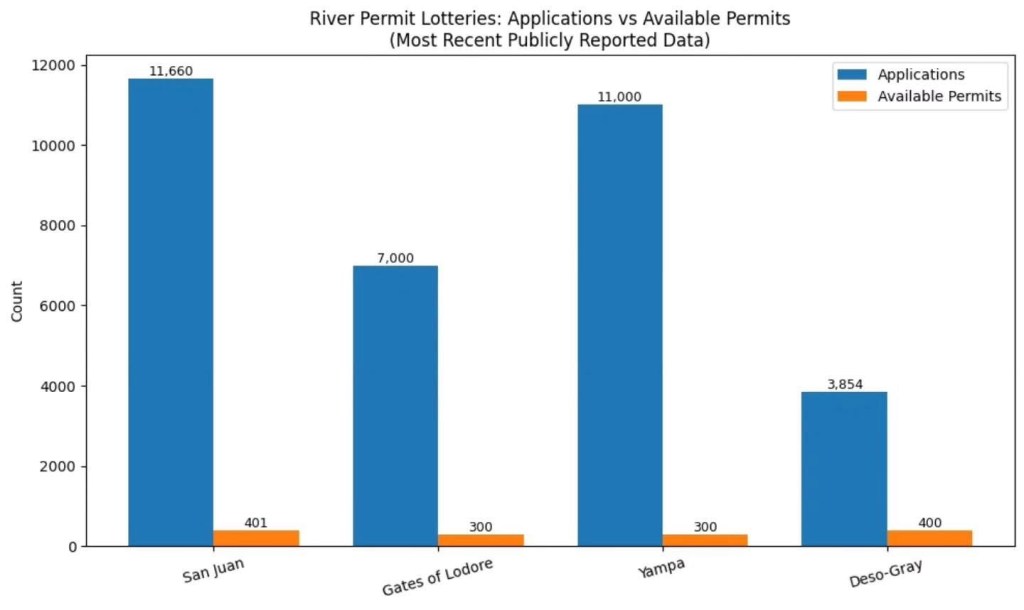
What could work, specific to river permits and lotteries? My thoughts:
- Right-size the balance between demand and capacity. That does not mean opening up rivers to all-comers, regardless of short- or long-term environmental, social, or economic impact. In my mind it means annually assessing the actual capacity of the river based on impacts, and regularly modulating both demand (how many permits are issued) and impact (campsite closures, use changes – think burn bans or designated campsites) based on those assessments.
- Right-size the balance between different demands. Commercial permit-holders (another group trying to maximize shareholder value) control the vast majority of permitted visitors. Are they using all their permitted ‘seats’ on each trip? Can we find a way to balance use-it-or-lose-it with the business’ need for some predictability and stability? Commercial permits are a lot like taxi medallions in NYC – lucrative and valuable because they’re hard to obtain and for a long time, the only mechanism to offer the service. How can the commercial permit structure change without a cataclysmic shift in that value that outfitters have used as a fairly liquid asset – avoiding what happened to those medallion-holders when Uber and Lyft began operations in that city.
- Apply non-winning application history as a weighting factor in the drawings. The Grand Canyon permit process already does this; factoring in the duration of an applicant’s documented interest in a particular river/segment has been a great way to help prioritize the use of the scarce resources (and they will remain scarce, even with all the other suggested changes) in a way that rewards persistence and patience.
- Align the incentives of the operators of the market with the participants in the market. The funds paid to Booz Allen should be directly related to the success of recreation.gov, with both up- and down-side risk. That success should be measured by the functioning of the process to the benefit of the Forest Service, the BLM, the NPS, and to recreational boaters. The funds paid to use the resources should be directly allocated back to the agencies responsible for those same resources, and should be used to improve the rivers, and access to those rivers.
- Promote transparency at all levels. Make public the near-real-time data around volumes, rates, improvements, changes, and expenses, at a granular level. Do this with just enough delay that it keeps the playing field level for all parties and does not allow for market manipulation.
- Vigorously reject market-manipulating use of technology. Implement and enforce lifetime bans on use of scripts, bots, and other automation to engage in access and arbitrage of non-lottery permits. Make this information publicly available, and use the risk of this consequence to reinforce appropriate behavior.
There are a lot of different participants in this process with their own sets of values when it comes to our rivers. Let’s make sure the way we use those beautiful, wild, scenic, and intrinsically valuable assets can allow them to remain truly public; don’t let them become victim to the perverse incentives that happen when only some ‘shareholder’ interests are ascribed value.
 Clean Lines Paddlesports
Leave a comment