
A decade or so ago I fumbled a relationship with a woman I was really, really into. We’re still in contact, but I haven’t seen her in person since before the pandemic, which is when I returned to whitewater after a multi-year hiatus. I’ve suggested she might like whitewater rafting (she paddles a SUP on flat water) and as part of that discussion we talked about fear, control, and exposure therapy. Ultimately these are a big part of why rafting is fun for me – at various points I described rapids as “a set of 4-D rollercoasters” and used the phrase “it’s not without risk” in describing rafting big water. Both phrases could describe life in general (see the aforementioned ‘me and relationships’). But risk, especially, is hard to process as abstract without some lived experience. Quantifying that abstract risk into tangible measurement is why insurance companies employ professional actuaries.
Risk management in whitewater boils down to the same general mitigation as everything else. If risk is the calculated output of likelihood and consequence, reducing either (or both) of the factors reduces the risk. Consequences range from “I spilled my beverage” to “someone died” – obviously a whole lot of room between these. Likelihood is just the equivalent of betting odds of that consequence happening at all.
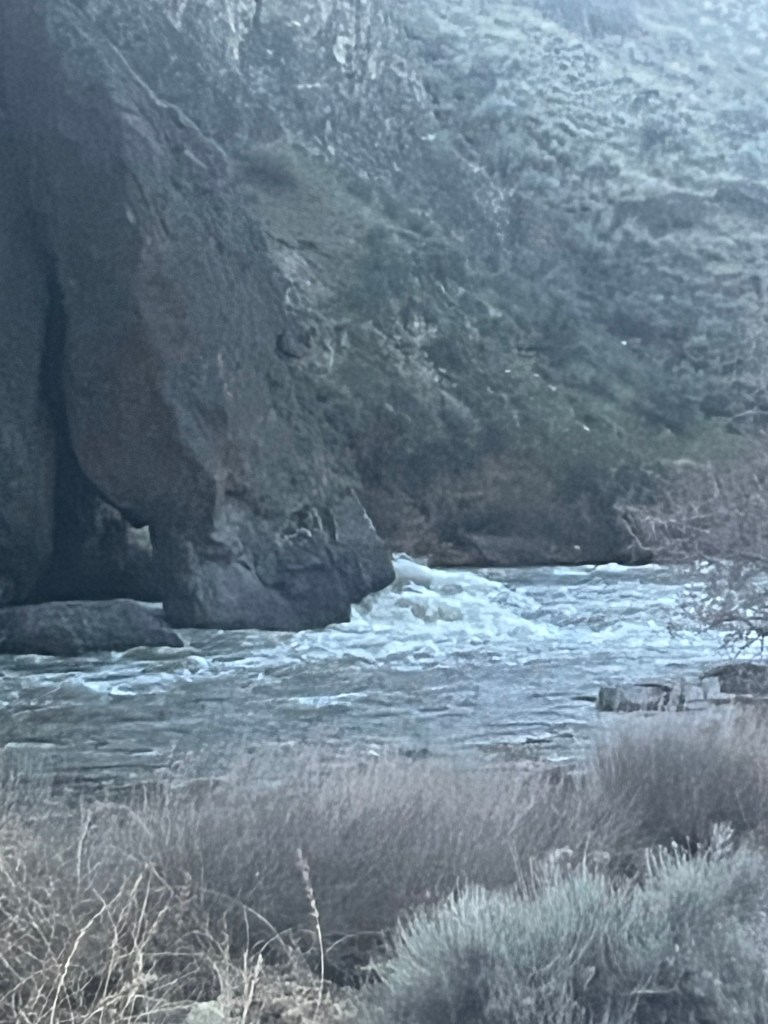
Reducing consequences in whitewater happens in a few ways. The biggest levers to pull are around personal, equipment, and group safety: don’t boat under the influence, wear safety equipment, go with a group, know something about the river and the rapids, set safety in advance, have a sweep boat, do a safety talk, rig to flip. These don’t make a swim, a pin, or a flipped boat less likely to happen but they do mean the outcome is more along the lines of “That water was COLD!” or “We got to camp late because it took some work to get the boat unstuck.”
Reducing likelihood can eliminate a risk entirely (ex: you’ll never be in a plane crash if you never fly) but for the most part in action sports – where there is always some assumed risk – the idea is to shift the likelihood of higher-consequence events to lower-consequence ones. If you have training and experience, your ability to make a specific move means you might ding your oar if you didn’t take a clean line, but you did it well enough to not wrap or flip your boat. Having a satellite communicator to call in SAR if someone isn’t breathing after a bad swim on a remote river means their chances of full recovery are exponentially greater. Having the right equipment for the conditions means you can use it when it’s needed, and having practiced using it means you’ll be more effective when you need to do so. Knowing how the river and rapids generally change in high or low water means you know better which moves to make, and comparing that with your experience means you know whether you are ready to tackle those scenarios.
Reducing consequences generally is more dynamic. You can put the helmet on at any time. You can stop and scout the rapid. You can talk with your group about making sure someone is acting as the sweep boat. Snug up that PFD before the rapid, just in case. Reducing likelihood gets back to one of the reasons I am opening the shop – access to the right equipment is a really important part of the process once you’re committed – to the trip, to the line, or to the outcome. You can’t put the helmet on if you couldn’t find one that fit. You might decide you will risk not wearing a drysuit because the closest ones to try on are a couple hours away. You can’t use oars that will stand up to that ding if it costs too much to ship them to you. You can’t trust that your boat will survive a z-drag and not get ripped apart if you can’t buy a quality one.
Risks are real in the whitewater world, just like they are in the rest of life. I try to be conscious and aware of them, and what I can do to reduce both likelihood and impact. Maybe enough that I can get that woman to go rafting with me at some point. And maybe take a risk on me making her dinner afterwards.
 Clean Lines Paddlesports
Leave a comment