
My undergrad is in biology, and specifically in molecular biology with a focus on plant physiology. I use the knowledge I gained in this study every day. Seriously, but probably not the way you’d expect. My definition of a good undergraduate education is one where you become expert at learning. Not expert on a specific topic or even in a general area, but expert at being able to form questions and draw conclusions based on a structured analysis that help answer those questions. I love to learn, and to apply what I have learned to other areas of my life.
One of the new applications of prior knowledge areas for me is around waves. In plant physiology waves are exceptionally important. The most important waves are electromagnetic ones (waves of a specific frequency on the visible light spectrum excite the electrons in chloroplasts, allowing plant cells to lyse CO2 and form hydrocarbons and starches while respiring O2). The attributes of waves in water are the same in structure and function, though on a much more tangible scale. The frequency is the number of them that repeat in a specific distance. The amplitude is the distance of the peaks and troughs from an axial center line. The energy contained in the waves is a mathematical function of these factors. The waves move in specific directions and affect the acceleration, direction, and velocity of objects in their paths based on the vectors of the waves and the objects they’re acting upon. Waves can – depending on synchronicity – cross over each other and cancel out effects or undergo factorial increases in power through harmonic convergence. And when you’re in a raft and suddenly the waves are huge, harmonic convergence feels very, very important.
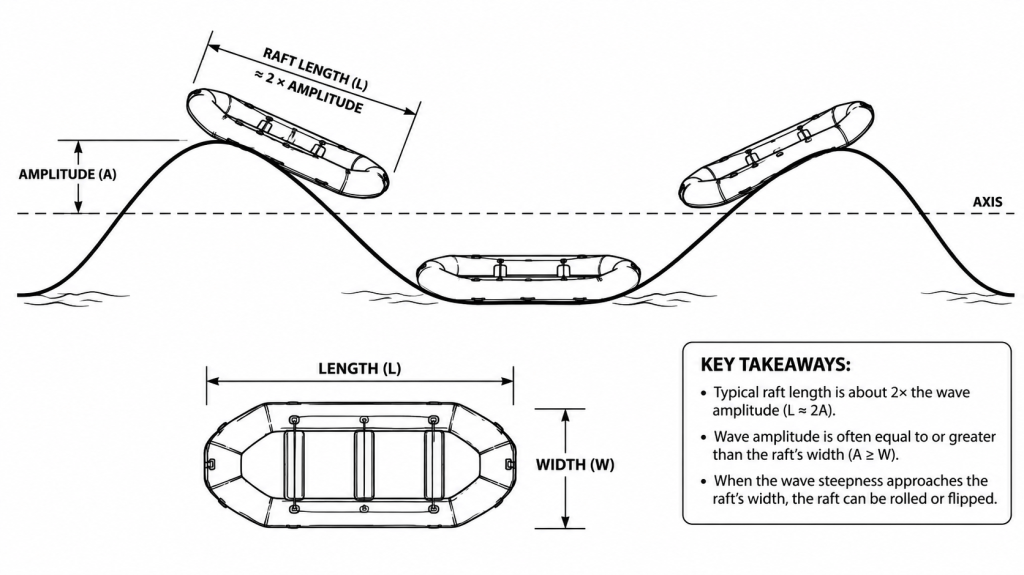
I was on the Main Salmon a few weeks ago, and the folks in IKs swam a few times, while the folks in rafts did not. Wave attributes are the main reason why. Lateral waves with an amplitude greater than the width of a watercraft can very easily flip the craft. A wider boat (or a longer one if hitting the wave head on) is just mathematically more stable. The convergence of several waves can exponentially increase the height and energy in the combined waveform, and that increase in amplitude and frequency will rock your world.
The material and preparation of your boat also factors in. Stories abound of old, seasoned rafters letting their bucket boats fill up with water as ballast prior to hitting big waves. Urethane boats (especially Sotar – my teen’s IK – and Wing – my round boat) don’t deflect or flex into the shape of the wave, and sometimes sit atop a pair of waves instead of bending between them. Changing tube and floor pressure can also affect this flexion. Moving coolers and gear to the bow provides some ballast to break through waves instead of getting tossed around by them.
The most straightforward thing you can do to avoid wave-caused problems is to make sure the longest part of your boat is as close to perpendicular as possible to the waves. A wave amplitude greater than 1/2 the width of your boat is a flipper. A 14’ raft is 6-7’ wide, so a 3’ wave sideways will raise the boat 3’ while the trough drops 3’, leaving your boat near vertical and the momentum flips it quickly. An 11’ IK is 3’ wide, so it only takes a 1.5’ wave.
Staying perpendicular to the wave is easy to say and hard to do. Multiple waves appear at different angles. Pulling towards lines or away from features is often in opposition to the current. So on big water, be sure to rig to flip… or wave goodbye to your loose gear if you do get sideways. Be safe. Have fun. Make good choices.


Leave a Reply